-
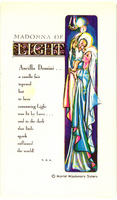 Madonna of Light holy card
approximately 1955; The Madonna of Light holy card includes an image of the Blessed Virgin Mary holding infant Jesus on her shoulder as he lights a candle. The card was published by the Marist Missionary Sisters circa 1955. Front includes a poem by Sr. M. M.; Ancilla Domini. A candle fair tapered but to bear consuming Light was lit by Love… and in the dark that little spark enflamed the world! (front) Ways of Helping Your Sister. The Way of Prayer: Mountains of them for vocations, for conversions, for God's blessings on our work. The Way of Alms: No offering is too small, none too great. The Way of Stamps: Cancelled stamps of every kind. No, we don't decorate the house with them, we sell them to philatelists and use the revenue for our Missions. The Way of Subscribers: By subscribing to our bi-monthly magazine, our periodical contact with our friends. The Way of Vocations: American young women who wish to give their lives to God in the service of the Foreign Missions. The Way of New Friends: To take the place of those who have gone, to say a word for us to those who know us not, to become sub-missionaries, helping from behind the lines. (back)
-
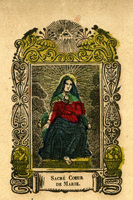 Sacré Cœur de Marie holy card
approximately 1840; Hand-colored holy card depicting the Blessed Virgin Mary with Immaculate Heart, surrounded by a decorative border with baskets of fruit, flowers, birds, and eye.; Sacré Cœur de Marie.
-
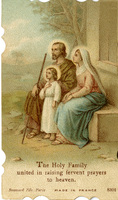 Holy Family holy card
approximately 1910; Mary and Joseph sit on a stone bench outside of a building. The child Jesus stands between them; Joseph's hand is placed on his shoulder. Trees are visible in the background. The back of the card is blank. This card was printed by Boumard Fils in the early twentieth century.; The Holy Family united in raising fervent prayers to heaven.
-
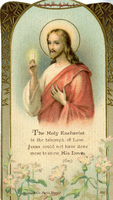 Holy Eucharist holy card
approximately 1910; Portrait of Jesus, wearing white and red robes. He holds the eucharistic host in his right hand. Below the portrait is a quotation by an unidentifiable author about the Holy Eucharist. The bottom of the card has white flowers, and the sides have embossed gold stars. Above Jesus is a branch of thorns. The back of the card is blank. This card was printed by Boumard Fils in the early twentieth century.; The Holy Eucharist is the triumph of Love. Jesus could not have done more to show His Love. (Gay)
-
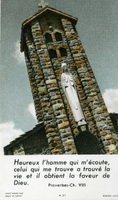 Mary and church photograph holy card
approximately 1930; Tinted photograph of a stone church with a statue of Mary over the front entrance. Below the photograph is a verse from Proverbs. The back of the card is blank. This card was published by Bouasse Jeune at an unknown date, early in the twentieth century.; Heureux l'homme qui m'écoute, celui qui me trouve a trouvé la vie et il obtient la faveur de Dieu. Proverbes-Ch. VIII.
-
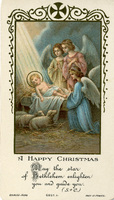 Happy Christmas holy card
approximately 1920; The baby Jesus sleeps in a manger filled with hay. Rays of light shine on him from above. Two angels stand behind the manger, while a third kneels before Jesus. Two lambs lie beside the manger. Below the illustration is a quotation about the Star of Bethlehem. The back of the card has a handwritten inscription. This card was published by Bouasse-Jeune sometime in the early twentieth century.; A Happy Christmas. May the star of Bethlehem enlighten you and guide you. (S. + C.) (front) From Your Organist. (back)
-
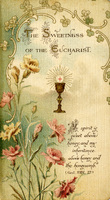 Sweetness of the Eucharist holy card
approximately 1915; Booklet holy card. Front cover illustration shows a golden chalice in the center, with a red cross above it surrounded by gold rays. Above the chalice are green shamrocks; to the left of the chalice are pink and yellow flowers. Below the chalice is a passage from Ecclesiastes. The inside of the booklet contains passages about the Eucharist from Father Joseph Huby, S.J. (1878-1948), Saint Alphonsus (1696-1787), and Bishop Hector-Albert Chaulet d'Outremont of Le Mans, France (1812-1874). The back of the booklet contains the rest of the d'Outrement quotation, and a passage by Father Armand de Ponlevoy. The back also has a handwritten inscription of five lines from the hymn 'O Sacrament Most Holy' and the date January 8, 1915. Printed by Bouasse-Jeune.; The Sweetness of the Eucharist. 'My spirit is sweet above honey, and my inheritance above honey and the honeycomb.' (Eccl. XXIV, 27.) (front) Eucharistic Sweetness. In what is the heart of Jesus more tender, more sweet than in this mystery of love, the Holy Eucharist? The Holy Gospels, it is true, teach us sweetness and charity, but it is only from Jesus that come to us the strength and grace to practise these lovely virtues. It is through the Eucharist that we overcome our antipathies and our rancour; it is from the Eucharist that we learn to love, that we learn to forgive, for this ineffable Sacrament is a mystery of sweetness and of love. Impregnate, then, your souls with sweetness by receiving frequently Him who is all goodness, all charity. The almight Master will teach you the divine science of being sweet and good, tender and patient towards all men and for the sake of all. (Père Huby.) We must be gentle and kind towards all men in all circumstances and at all times. He who would sanctify himself must be here below like a lily among thorns: whatever pricks he may feel, he must never cease to be a lily, I mean he must be both gentle and agreeable. A humble meekness and gentleness is the virtue of virtues, which Our Lord recommended to us so much: that is why we must practise it ever and everywhere. This virtue so dear to the Heart of Jesus will merit for us, moreover, His mercies and His graces. Alas! how we do try the patience of Our Lord! and what need we have of His mercy! We live, so to say, on the merciful tenderness of God who is so good, it is this which bears with us, pardons us, and keeps hope alive in our hearts. Let us in turn practise meekness and charity, let us be meek and patient with the poor, and with the sick, but let us be above all thing generous towards our enemies. We must overcome hatred by love, and persecution by meekness. It was thus that the Saints did, it was by such means that they triumphed over their most inveterate enemies. (St. Alphonsus.) Nothing is so edifying as a charitable meekness. It radiates from the brow of the Saint and renders him victorious over men and devils. To be meek is to be strong. To know how to keep our serenity in the midst of the difficulties and sufferings of life, is almost to triumph over them. But forget not that you will draw such strength from God alone, in His Sacrament (inside) of the Eucharist. Your heart must be wholly possessed by the grace of Our Lord, you must experience the divine influence exercised by this adorable mystery. You must receive into you the life of Jesus, in order to be able to live His life of meekness and of charity. (Mgr. d'Outremont.) Love brought Jesus down into the Eucharist: His meekness and His tenderness in our regard keep Him there. Yes, in spite of our lukewarmness, in spite of the ingratitude of our hearts, Jesus abides amongst us, our consoler in our wretchedness, our stay in our weakness, our living refuge and succour. O ineffable meekness of Jesus in His mystery of love, who will give me the heart to understand you and to love! (Père de Ponlevoy.) O Sacrament most holy, O Sacrament divine, All praise and all Thanksgiving Be every moment Thine. 'At the elevation of the Host.' Jan 8, 1915. (back)
-
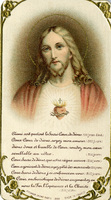 Sacré Cœur holy card
approximately 1900; Portrait of Jesus and the Sacred Heart. Below the illustration are prayers to the Sacred Heart. The edges of the card feature an embossed border of gold flowers. The back of the card has a handwritten inscription. This card was printed by Bouasse-Jeune around the turn of the century.; Aimé soit partout le Sacré Cœur de Jésus. (100 jours d'ind.) Doux Cœur de Jésus, soyez mon amour. (300 jours) Jésus doux et bumble de Cœur, rendez mon cœur semblable au vôtre. (300 jours) Cœur Sacré de Jésus, que votre règne arrive. (300 jours) Cœur agonisant de Jésus, ayez pitié des mourants. (300 jours) Cœur Sacré de Jé, j'ai confiance en vous. (300 jours) Cœur eucharistique de Jésus, augmentez en nous la Foi, l'Espérance et la Charité. (300 jours) (front) Souvenir N.D. de Lourdes En union de prierè. R. Muller. (back)
-
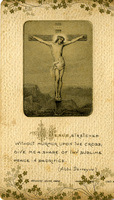 Crucified Jesus holy card
approximately 1900; Black and white image of Jesus crucified on Mount Calvary. Below the illustration is a quotation from Father Henri Perreyve. The top and the bottom of the card have embossed green flowers. The back of the card is blank. This card was printed by Bouasse-Jeune around the turn of the century.; O Jesus, stretched without murmur upon the cross, give me a share of thy sublime peace in sacrifice. (Abbé Perreyve)
-
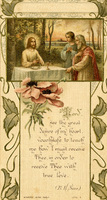 Communion with Jesus holy card
1921; Jesus is seated or kneeling behind a table covered in white cloth. On the table are a chalice and a plate; Jesus holds the Host over the plate. A young boy stands next to the table with hands clasped in prayer, and an old man kneels next to the table. Behind them are trees and a lake. Below the illustration are red flowers and a quotation from Blessed Henry Suso. The sides of the card are bored with an embossed green and gold leaf pattern. The back of the card has a handwritten inscription from a nun to a girl in remembrance of her 'Great Day,' perhaps the day of her First Communion, on June 6, 1921. Printed by Bouasse-Jeune.; Lord, see the great desire of my heart, vouchsafe to teach me how I must receive Thee, in order to receive Thee with true love. (B. H. Suso) (front) To dear Henrietta, In loving remembrance of your 'Great Day'; Sister M. de Pazze June 6, 1921. (back)
-
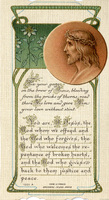 Jesus wearing crown of thorns holy card
approximately 1910; A bronze colored profile portrait of Jesus wearing a crown of thorns is in a circle. Next to the portrait are three flowers on a green background; below is a prayer. All are surrounded by a gold and green frame. The portrait of Jesus is embossed. The back of the card is blank. This card was printed by Bouasse-Jeune at an unknown date early in the twentieth century.; Fix your gaze on the brow of Jesus, bleeding from the pricks of thorns, read there His love and give Him your love without stint. You are, O Jesus, the God whom we offend and the God who forgives, the God who welcomes the repentance of broken hearts, and the God who gives back to them justice and peace.
-
 Sincere Affection holy card
approximately 1910; A purple and yellow flower, possibly an iris or lily, with green leaves. A green and gold decorations surround it. The back of the card has a handwritten inscription from a Mother M. Philothea. This card was printed by Bouasse-Jeune at an unknown date early in the twentieth century.; Sincere Affection. May all good things be yours; may every blossom of my hope bear its fruit in due season for your hands. (front) Mother M. Philothea (back)
-
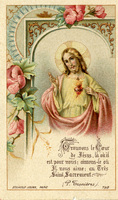 Jesus and Sacred Heart holy card
approximately 1910; Jesus is wearing white and red robes, with one hand raised in blessing and the Sacred Heart visible. His image is framed by red roses and a gold filigree pattern. Below the illustration is a quotation from a Father Teonieres. The back of the card is blank. This card was printed by Bouasse-Jeune at an unknown date, early in the twentieth century.; Trouvons le Cœur de Jésus, là où il est pour nous; aimons-le où Il nous aime; au Très Saint Sacrement. (P. Teoniéres)
-
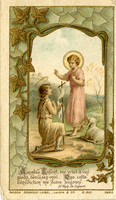 Aimable Enfant holy card
between 1907 and 1924; The child Saint John the Baptist kneels before the child Jesus, who has one hand raised in blessing. John is holding a staff shaped like a cross. A lamb lays next to Jesus. The scene is framed by gold and green ivy. Below the illustration is a quotation from Saint Alphonsus de Liguori. The back of the card is blank. This card was printed by Maison Bouasse-Lebel and their subsidiary Lecène & Companie sometime between 1907 and 1924.; Aimable Enfant, me voici à vos pieds, bénissez-moi… Que cette bénédiction me suive toujours. St. Alph. De Liguori.
-
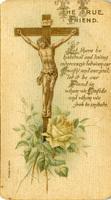 The True Friend holy card
between 1907 and 1924; Booklet holy card. The front cover has a statue of Jesus on the crucifix; at the base of the sculpture is a white rose and thorn branches. The inside of the booklet has unattributed reflections on the crucifixion. The back cover has the letters HIS encircled by a wreath of thorns. This card was printed by Maison Bouasse-Lebel and their subsidiary Lecène & Companie sometime between 1907 and 1924.; The True Friend. Let there be habitual and loving intercourse between our Crucifix and our soul; let it be our Friend in whom we Confide and whom we seek to imitate. (front) The Crucifix. Lord, the hour of my distress has come and I have been unable to bear it. I felt all my inward strength failing at once beneath the burden of an overpowering bitterness, a torrent of tears suddenly arose and sprang from my eyes. In this agony, the violence of which frightened me, I sought for succour; I cast my eyes around me I thought that so much suffering would finally call forth a Comforter; but I was alone and the Consoler did not appear. Then I perceived Thine image, O Christ; the instinct of salvation drew me towards It; I seized It with a trembling hand, and my face, bathed in tears, rested upon it. How much we cry over Thine image, O divine Crucified One! The tears of men know It well. There is between Thy Cross and human sorrow an eternal sympathy. Through my tears I looked at Thy Hands pierced for the love of men: my lips felt the nails which fastened Thy feet, and my hand tightly holding Thy Image rested on Thy wounded Heart. What did I say? What did I hear? I could not repeat it to myself. I remained long in union with Thee, kissing Thy wounds, holding in my hands Thy head crowned with thorns, losing myself in Thy Cross. For a long while I bathed with tears that Cross which Thou didst bath with Thy blood. I had no strength to pronounce one word, but, in the bottom of my heart, was the word which Thou, O Jesus, didst utter at the supreme moment: Father, unto Thy hands I commend my spirit. For a long while I followed the echo of that word, in all the folds of my soul, peering into depths I had ignored. Then peace came; I fell asleep as it were on Thy Heart, and little by little love conquered suffering. A strange, unhoped-for consolation which I felt did not come from myself, gently entered into my spirit, and while I was surprised at such a sudden change, that sweetness grew until it became like unto joy. Calm strength came to me. I felt I was renewed for the battle, and that my will had been seven times immersed in the Blood of the Lamb. O Cross of Jesus, Sublime Comforter, I shall never forget what Thou canst do against the overwhelming waters of despair and how Thou canst transform burning tears into peace and sweetness. (inside) IHS (back)
-
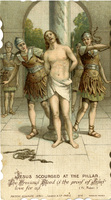 Jesus scourged holy card
between 1907 and 1924; Image of the Scourging from the Passion of Christ. Jesus, wearing white linens, stands at a marble pillar. Two Roman soldiers scourge him with whips, while two other soldiers look on. Below the image is a quotation from Father Frederick William Faber. The back of the card is blank. This card was printed by Maison Bouasse-Lebel and their subsidiary Lecène & Companie sometime between 1907 and 1924.; Jesus scourged at the pillar. The Precious Blood is the proof of Jesus' love for us. (Fr. Faber.)
-
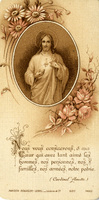 Sacred Heart holy card
between 1907 and 1924; A sepia illustration of Jesus featuring the Sacred Heart, framed by a white oval. Surrounding the frame are pink daisies and roses. Below the illustration is a quotation from Cardinal Léon-Adolphe Amette. The back of the card is blank. This card was printed by Maison Bouasse-Lebel and their subsidiary Lecène & Companie sometime between 1907 and 1924.; Nous vous consacrons, o Cœur qui avez tant aimé les hommes, nos personnes, nos familles, nos armées, notre patrie. (Cardinal Amette.)
-
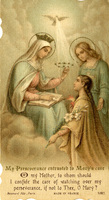 Mary's care holy card
approximately 1915; Mary is seated with an open book in her lap. She is holding a crown of gold stars in one hand. A girl holding a bouquet of white lilies kneels before her to receive the crown. An angel stands behind the girl. Rays of light beam down on the crown from a white dove above. The back of the card has a handwritten inscription from a Sister Fausta, dated 1915.; My Perseverance entrusted to Mary's care. O my Mother, to whom should I confide the care of watching over my perseverance, if not to Thee, O Mary? (front) A little remembrance from dear Sister Fausta May 9th 1915. (back)
-
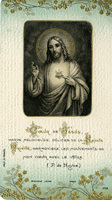 Cœur de Jésus holy card
approximately 1900; Black, white and gold portrait of Jesus featuring the Sacred Heart. Below the illustration is a quotation from Blessed Bernardo de Hoyos. The top and bottom of the card feature embossed gold flowers on a blue background. The back of the card is blank. This card was printed by Bouasse-Jeune around the turn of the century.; Cœur de Jésus, harpe mélodieuse, délices de la Saints Trinité, harmonisez les mouvements de mon cœur avec le vôtre. (P. de Hoyos.)
-
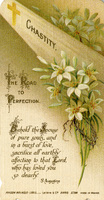 Chastity holy card
between 1907 and 1924; A bouquet of white lilies is encircled by a wreath of thorns. A beam of light shines on the bouquet containing a gold cross and the word 'Chastity.' Next to the bouquet is a quotation from Saint Augustine. The back of the card is blank. This card was printed by Maison Bouasse-Lebel through their subsidiary, Lecène & Companie, sometime between 1907 and 1924.; Chastity. The Road to Perfection. Behold the Spouse of pure souls, and in a burst of love, sacrifice all earthly affection to that Lord, who has loved you so dearly. St. Augustine
-
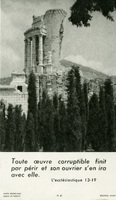 Ruins photograph holy card
approximately 1930; Black and white photograph of the ruins of a church or temple. The building was built of stone, and includes pillars. In the background is a mountain; in the foreground are trees. Below the photograph is a verse from Ecclesiastes. The back of the card is blank. This card was printed by Bouasse Jeune in the early twentieth century.; Toute œuvre corruptible finit par périr et son ouvrier s'en ira avec elle. L'ecclésiastique 13-19.
-
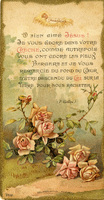 Bien Aimé Jésus holy card
10-29-1906; At the top of the card is the Baby Jesus sleeping on a bed of hay. In the center of the card is a quotation in French from Father Leonard Goffiné (1648-1719), a German priest. Below the quotation is a bouquet of pink roses, with grass and leaves visible in the background. Printed on the back of the card are three translations of a prayer for obtaining a plenary Indulgence near death, in English, French, and Italian. The back of the card has the imprimateur permissions from the Archdiocese of Marianapoli (Montreal, Canada) and Auxiliary Bishop Zotique Racicot; the prayers were likely printed there onto cards imported from France.; O bien aimé Jésus! Je vous adore dans votre Crèche, comme autrefois vous ont adoré les pieux Bergers et je vous remercie du fond du Cœur d'être descendu du Ciel sur la Terre pour nous racheter. (P. Goffiné) (front) Prière à réciter pour gagner l'indulgence plénière à l'article de la mort. Quiconque, après avoir confessé ses fautes et reçu la sainte Communion, récitera cette prière, même longtemps avant la mort et en pleine santé, gagnera une indulgence plénière qui lui sera appliquée au moment de sa mort. Prière.--Seigneur mon Dieu, dès maintenant, quel qu'en soit le genre et selon qu'il vous plaira, d'un cœur tranquille et soumis, j'accepte de votre main la mort avec ses angoisses, ses peines et ses douleurs. A prayer to be recited for the gaining of a plenary Indulgence at the hour of death. A Plenary indulgence for the hour of death has been granted for the recitation of the following prayer, with a contrite heart, after confession and Holy Communion, on any day according to one's choice: Prayer.--O Lord my God, from now I accept whatever kind of death Thou hast destined for me, with all its anguish, pains and sorrows. Preghiera da recitarsi pér lucrare l'Indulgenza plenaria all'ora della morte. Chiunque, dopo essersi confessato e aver ricevuta la Sta Communione, reciterà guesta preghiera, anche molto tempo prima della morte ed in ottima salute, quadagnerà un Indulgenza plenaria che gli sarà applicata al momento della morte. Preghiera.--Signore mio Dio, da questo momento io accetto qualunque genere di morte, con tutte le sue pene, angosce, e tribulazioni che Voi, o mio Dio, avete servato per me. Imprimatur: Marianapoli, die 29 Octobris 1906. Zoticus, Ep. Poglensis, V.G. (back)
-
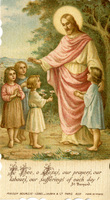 Jesus and children holy card
between 1907 and 1924; Jesus, wearing red and white robes, stands with four children, his arm around one. A girl holds a bouquet of daisies, and is presenting Jesus with a flower. The other children have their hands clasped in prayer. In the background are trees. Below the illustration is a quotation from Saint Bernard. The back of the card is blank. This card was printed by Maison Bouasse-Lebel and their subsidiary, Lecène & Companie, sometime between 1907 and 1924.; To Thee, o Jesus, our prayers, our labours, our sufferings of each day! St. Bernard.
-
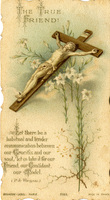 The True Friend holy card
approximately 1915; A wooden crucifix with a white sculpture of Jesus. In the background are blue skies, clouds, lily flowers, and branches of thorns. Below the illustration is a quotation from Father Gustave de Ravignan. The back of the card has a handwritten poem about Jesus with no author attribution. This card was printed by Maison Bouasse-Lebel at an unknown date.; The True Friend. Let there be a habitual and tender communication between our Crucifix and our soul, let us take it for our Friend, our Confidant, our Model. (P. de Ravignan.) (front) I. O Jesus dear, O Jesus dear, I am so glad to have Thee here, Although Thou art so weak and small Thou art my God, and Lord of all. II. O Babe divine, O Babe divine, Just for a little Thou art mine And I can press Thee to my heart All, my, great and holy as Thou art. III. My brother sweet, my brother sweet, I kiss thy tender little feet. And lay my face against Thy, feet, cheek And am to happy quite to speak. Amen. (back)
-
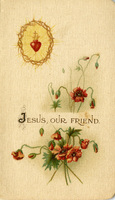 Jesus Our Friend holy card
approximately 1900; Booklet holy card. Front panel features an illustration of the Sacred Heart framed by a crown of thorns and a bouquet of red roses. The inside features passages from Thomas à Kempis's 'The Imitation of Christ,' John's Gospel, and a prayer by Father Albert Tesnière. The back of the card features verses from Ecclesiastes, Proverbs, and 'The Imitation of Christ.' This card was printed by Bouasse-Jeune around the turn of the century.; Jesus, our friend. (front) Jesus, our friend. 'The love of Jesus is faithful and enduring… Love Him and keep Him for thy Friend. Keep close to Jesus in life and in death, and commit thyself to His keeping, who alone can help thee when all others fail.' (Imitation, II, VII.) "It is a great art to know how to converse with Jesus; and to know how to keep Jesus is great wisdom." (Imitation, II, VIII). Friendship is Mutual. Friendship is mutual; you cannot be our friend, O Jesus, wihtout our becoming Thine. This name of friend, the grace to be able to love as friends, the unspeakable honour and power of a real friendship with Thee, all this Thou didst bestow upon us at the Last Supper, immediately after the institution of the Holy-Eucharist, as though to tell us that it is in this Sacrament we become Thy friends, capable of loving Thee, worthy of doing so, and finding in the Eucharist itself the occasion of and the most favourable aid to friendship. 'I will not now call you servants...But I have called you friends because all things whatsoever I have heard from My Father, I have made known to you' (St. John XV. 15) Friendship desires Union. Friendship desires union of souls, and tends thereto with all its strength, it desires a union as close, as intimate, as perfect as possible. Its ideal and its perfection, its rest and its happiness, consequently, are found in complete and absolute unity. 'Ex ambobus fieri unum.' But Thou alone, O perfect Friend, Thou alone offerest plenarily to our heart the realization of this desire, the satisfaction of this need! Thy sanctifing grace makes us one with Thee through participation in the same divine life. 'Thou in Me, and I in them.' Gratitude to Jesus, our Friend. How can we thank sufficiently our Divine Friend for the gift of His friendship, in which we receive not only the highest honour, the most powerful helps, the most sure support, consolation in our trials, counsel in our doubts, compassion when we fall, but, still further, grace, and example, and security in all our friendships with our fellow men. Prayer. O Jesus! upon whose Bosom I may repose my weary head, and feel beating therein the Heart of the most devoted, the most delicate, the most tender of friends; Jesus, in whom is the source, the reason, the model and the security of all true friendship; jesus, the Friend, I adore Thee, I cast myself at Thy feet, I recognize Thee and I choose Thee once again as the best of all friends! How worthy of love Thou art, O my well-beloved Friend! (Father Tesnière). (inside) A faithful friend is a strong defence; and he that hath found him, hath found a treasure. (Eccl. VI, 14.) Nothing can be compared to a faithful friend, and no weight of gold and silver is able to countervail the goodness of his fidelity. (Eccl., VI, 15.) A faithful friend is the medicine of life and of immortality. (Eccl. VI, 16.) Without a friend thou canst not well life; and if Jesus is not thy friend above all others, thou shalt be sad and desolate indeed. (Imitation, II, VIII.) He that is a friend loveth at all times; and a brother is proved in distress. (Proverbs, XVII, 17) (back)